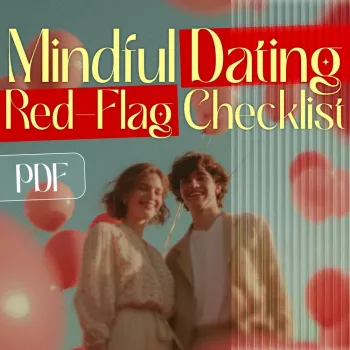
Mindful Dating Red-Flag Checklist: A Practical Printable for Emotional Safety and Boundaries
Dating can feel exciting and uncertain at the same time—especially when early chemistry makes it easy to overlook warning signs. A mindful, written checklist helps slow the pace, clarify boundaries, and notice patterns before they become painful. This guide explains how to use a printable red-flag checklist to protect emotional safety, spot concerning behaviors early, and make grounded decisions without overthinking every interaction.
What “emotional safety” looks like in early dating
Emotional safety isn’t about never feeling nervous—it’s about feeling respected and steady enough to be yourself. In the first few dates, look for these baseline signals:
- Consistency between words and actions: plans, follow-through, and communication style generally match what’s promised.
- Respect for “no” and “not yet”: you can set limits without pressure, sulking, or punishment.
- Room for individuality: friendships, hobbies, and privacy aren’t treated like threats.
- Healthy conflict: disagreements don’t include intimidation, insults, blame-shifting, or silent treatment.
- A calm baseline: excitement can exist without chaos, dread, or constant guessing.
Green flags vs. yellow flags vs. red flags (and why the difference matters)
Not every awkward moment is a warning sign. A helpful checklist separates “human imperfections” from patterns that predict harm.
- Green flags are repeated behaviors that build trust: accountability, empathy, reliability, and respectful communication.
- Yellow flags are “pause and observe” signals: mixed messages, rushed intensity, or unclear intentions that need clarification.
- Red flags are patterns that predict harm or instability: coercion, manipulation, dishonesty, threats, or boundary violations.
- A checklist works best when it tracks patterns over time, not one-off moments.
- If safety is in question (stalking, threats, isolation, coercive control), prioritize immediate support and distance—no checklist replaces help. For warning signs, see the National Domestic Violence Hotline.
Quick guide to dating flags
| Flag type |
How it shows up |
Best response |
| Green |
Consistent effort, respectful pacing, takes responsibility |
Continue slowly; keep communicating needs |
| Yellow |
Hot-and-cold texting, vague relationship goals, mild defensiveness |
Ask direct questions; set a small boundary; watch follow-through |
| Red |
Pressure, guilt, insults, jealousy framed as love, lying, boundary crossing |
Create distance; seek support; end contact if needed |
Common red flags to track (organized by category)
Red flags often cluster. Noticing categories helps you see the “shape” of the dynamic instead of getting stuck on a single incident.
- Communication: frequent stonewalling, mocking feelings, degrading “jokes,” sudden disappearances followed by excuses, refusing to clarify intentions.
- Boundaries: pushing physical intimacy, arguing with limits, repeated “accidents,” using alcohol to blur consent, showing up uninvited. (For consent basics, reference RAINN’s consent guidance.)
- Accountability: never apologizes, always the victim, blames exes for everything, rewrites conversations, denies obvious facts.
- Control and jealousy: monitoring, demanding passwords, criticizing friends/family, discouraging time alone, love-bombing followed by withdrawal.
- Values and integrity: consistent dishonesty, secretive behavior that doesn’t match stated commitment, inconsistent stories, financial manipulation. (For emotional abuse indicators, see the American Psychological Association.)
How to use a printable checklist without becoming hypervigilant
A checklist should support clarity—not turn dating into a high-alert investigation. Keep it simple and scheduled.
- Set a rhythm: review after dates or weekly. Avoid “live scoring” in the moment.
- Track frequency and impact: one minor slip differs from a recurring pattern that escalates or leaves you anxious.
- Use clear prompts: “What happened?” “How did it feel?” “Did I express a boundary?” “What was the response?”
- Pair observations with a next step: clarify, set a boundary, slow down, or step away.
- Ground in facts: write the exact quote or behavior; avoid mind-reading; focus on what’s observable.
Boundary scripts that keep you safe (and reveal character fast)
Boundaries don’t just protect you—they also show you how someone handles disappointment. Use short, calm statements and watch what happens next.
- Pacing: “I like you, and I’m taking things slowly. I’m not ready for that yet.”
- Clarity: “What are you looking for right now—casual, exclusive, or something else?”
- Respect: “Please don’t talk to me that way. If it continues, I’m ending the date.”
- Consistency: “When plans change last-minute repeatedly, I don’t feel prioritized. I need more reliability.”
- Digital boundaries: “I don’t share passwords or location. Trust matters to me.”
A simple decision framework for “stay, slow down, or step away”
When emotions are strong, decisions get muddy. Use a repeatable framework to reduce second-guessing.
Printable checklist: what it includes and how to print it for real-life use
A well-designed printable makes it easier to notice patterns without spiraling. The Mindful Dating Red-Flag Checklist (Printable) is built for real-life notes—quick to use, private, and structured.
If you prefer to keep your checklist digitally and print only when needed, a simple accessory like the Wireless Rechargeable Bluetooth 5.1 Mouse for Apple Devices can make reviewing, annotating, and organizing your notes faster—especially when you’re toggling between a calendar, messages, and your reflection prompts.
FAQ
How early is too early to use a red-flag checklist while dating?
It can be useful from the first few interactions as a reflection tool, especially if you tend to move quickly when there’s chemistry. Focus on tracking patterns over time rather than nitpicking isolated awkward moments, and prioritize immediate support if safety concerns arise.
What if something feels “off” but nothing obvious has happened?
Write down the specific moments that stood out, then set a small boundary or ask a direct question and watch the response. “Off” feelings often become clearer when you compare your notes to consistent behavior over the next few interactions.
Can a checklist help with anxious attachment or does it make it worse?
It can help when used calmly—on a schedule, grounded in facts, and focused on boundaries and actions rather than reassurance-seeking. If anxiety feels intense or obsessive, adding support from a trusted professional can help you use tools like this without spiraling.
Recommended for you










Leave a comment