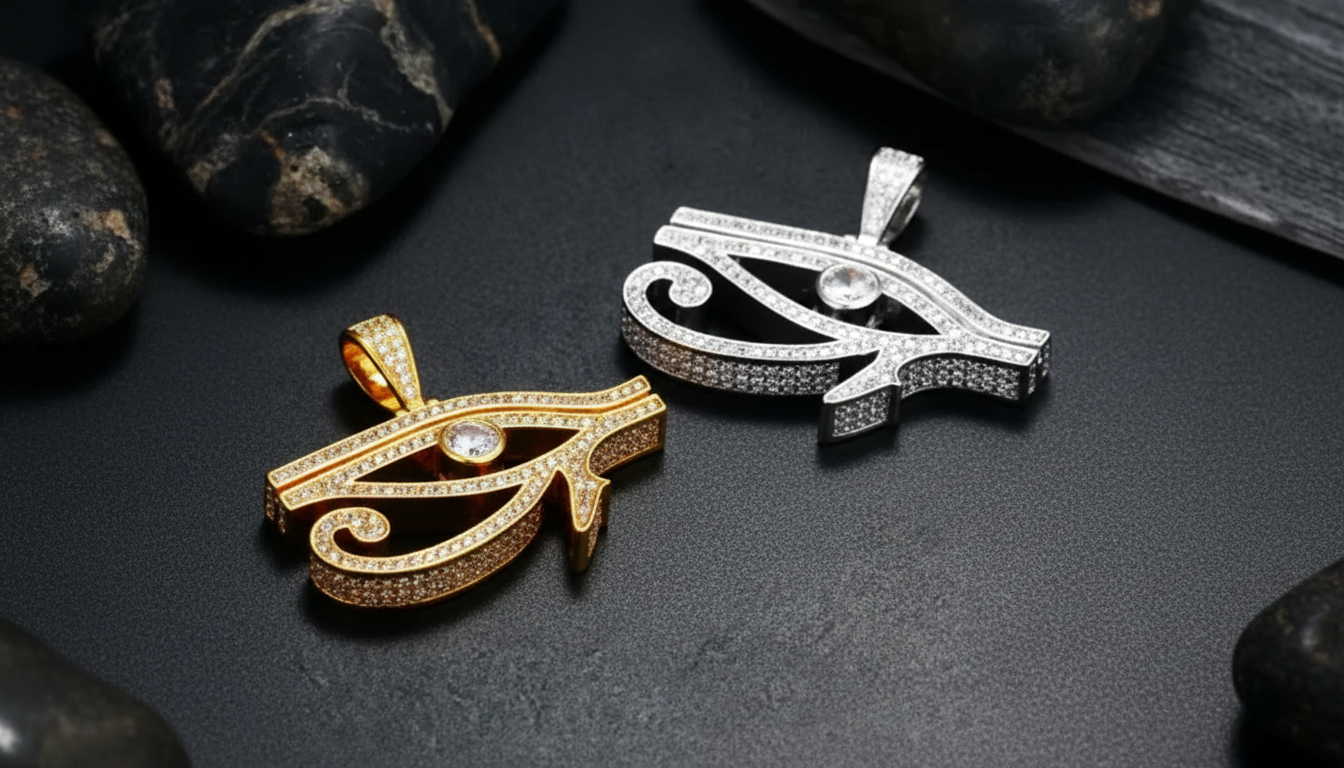
A bold Eye of Horus pendant can work as everyday jewelry, a meaningful symbol, or a standout finishing touch for streetwear and minimalist looks. The graphic lines of the eye read clearly from a distance, which is why it pairs well with simple tees, open-collar shirts, and layered chains. Below is a practical guide to what the Eye of Horus represents, how to style it, what to look for in a solid pendant-and-chain set, and how to keep it looking sharp over time.
In ancient Egyptian tradition, the Eye of Horus is commonly associated with protection, well-being, and restoration. Many people wear it as a personal emblem—some for cultural or historical interest, others for the idea of “watchfulness” and resilience through hard seasons. Because the design is crisp and recognizable even at smaller sizes, it works equally well as a subtle everyday pendant or as a statement piece.
If you want deeper historical context, sources like Encyclopaedia Britannica’s entry on the Eye of Horus and the Metropolitan Museum of Art’s Egyptian Art overview offer helpful background.
Not every pendant necklace feels the same day-to-day. Small construction choices can make the difference between a piece you reach for constantly and one that ends up sitting in a drawer.
| Feature | Why it matters | Good sign |
|---|---|---|
| Pendant finish | Comfort and appearance over time | Even plating/finish with no rough spots |
| Bail connection | Reduces twisting and wear | Bail sits centered and feels secure |
| Chain clasp | Daily convenience and security | Closes smoothly and holds firmly |
| Pendant visibility | How it reads at a glance | Symbol details are crisp from arm’s length |
The Eye of Horus looks “finished” with very little effort, so it’s easy to build outfits around it. The main styling dial is how visible you want the pendant to be.
One easy rule: if your outfit already has loud graphics, wear the pendant slightly shorter or under the shirt; if your outfit is clean and minimal, let the pendant sit visible on the chest.
Chain length changes the whole vibe. The same pendant can look understated or statement-ready depending on where it lands on the torso.
| Length range | Typical placement | Best for |
|---|---|---|
| Short | Near collarbone | Subtle wear, office-friendly looks |
| Mid | Upper chest | Everyday outfits, easy layering |
| Long | Mid chest | Statement styling over outerwear |
A little routine care keeps a pendant necklace looking bright and clean, especially if it’s worn often.
For general best practices, the GIA jewelry care guide is a solid reference for safe, everyday maintenance.
If you want a ready-to-wear set, check the Eye of Horus Pendant Necklace for Men & Women. It’s an easy pick for daily wear, layering, or gifting when a bold symbolic design is the goal. Availability can change, so the product page is the best place to confirm current details.
No. They’re related concepts from ancient Egyptian tradition but are distinct symbols with different associations, and they’re often mixed up in modern usage because both are stylized “eye” motifs.
Yes—this is a unisex motif. The main styling differences come down to preference (chain thickness, length, and whether you layer it) rather than any gendered rules.
Wipe it gently with a soft, dry cloth after wearing, and avoid water, chemicals, and heavy polishing. Store it separately so it doesn’t rub against other jewelry, and treat plated finishes with extra care to prevent premature wear.









Leave a comment