
A proactive mindset is less about motivation and more about having a repeatable way to choose action over hesitation. A printable, structured guide can turn big goals into small prompts you can follow daily—especially when confidence, clarity, or time feels limited. The “move first, think forward” approach is simple: start with a small, controllable action, then use what you learn to plan the next step with more accuracy and less stress.
In real life, most people don’t get stuck because they can’t think of a plan—they get stuck because they’re trying to pick the perfect plan before they’ve gathered any real information. Moving first solves that.
Printables work best when you want structure without a complicated system. A good guide helps you translate intention into a short list of actions you can actually complete.
The best printable isn’t the one with the most pages—it’s the one you can use when you’re tired, busy, or unsure what to do next.
If you like the idea of “if-then” planning (a proven way to reduce hesitation), implementation intentions are a practical add-on to this approach: Implementation Intentions.
This workflow is meant to be fast. It’s not about doing more—it’s about starting sooner, then thinking with better data.
| When stuck on… | Move-first next step | Think-forward check (after) |
|---|---|---|
| Choosing the perfect plan | Run a 10-minute test version | What evidence did the test create? |
| Feeling unmotivated | Do the first 2 minutes only | Did starting change energy or clarity? |
| Fear of doing it wrong | Create a rough draft / prototype | What is the smallest improvement to make next? |
| Too many priorities | Pick one “must-do” outcome for today | What can be postponed without damage? |
| Overwhelm | List 3 controllables; do 1 now | What’s the next controllable action? |
When procrastination shows up, it often looks like “productive” avoidance—researching, organizing, tweaking, or waiting to feel ready. Understanding that pattern makes it easier to interrupt: Harvard Business Review.
If consistency has been shaky, a short reset works better than a dramatic overhaul. Treat the week as a series of small experiments.
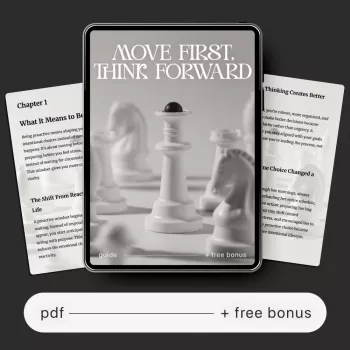
If you want a ready-to-use structure, the Move First, Think Forward printable self-improvement guide (digital download) is designed to support taking action before over-planning. It works well as a weekly reset tool or a daily decision aid when momentum is low, and the digital format makes it easy to reprint and reuse as routines change.
For digital check-ins (especially if you’re annotating PDFs or reorganizing weekly pages), a smoother setup can make the habit easier to maintain. A small upgrade like a Wireless rechargeable Bluetooth mouse for smoother digital planning can reduce friction during quick edits and reviews.
Proactivity is intentional action tied to an outcome, while busyness is often reactive—responding to every notification or request. A proactive day might include one high-impact task completed early; a busy day might feel full but produce little progress on what matters.
A 5–10 minute daily check-in plus a weekly review is enough for most people. Consistency matters more than intensity, and small steps compound when you repeat them.
Yes—open it in a PDF annotation app or notes tool and type directly onto the pages. Duplicating a fresh template weekly and saving past versions also makes progress easier to track.












Leave a comment