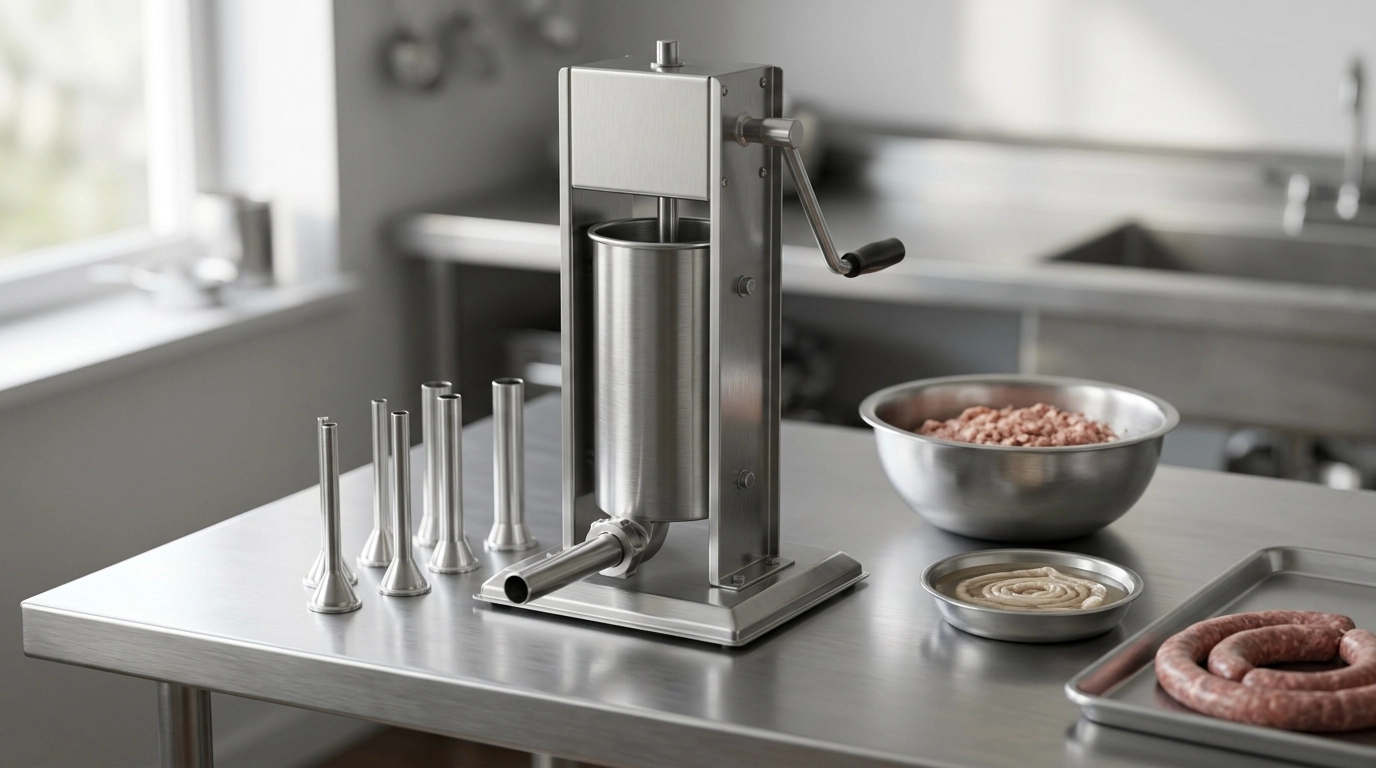
A vertical, hand-crank sausage stuffer is a practical way to produce consistent links without relying on a grinder attachment. This 7L stainless steel model is designed for larger batches, offering a stable, upright form factor and multiple nozzle options for different casing sizes. The focus is simple, repeatable stuffing: steady pressure, fewer air pockets, and better control over fill density—useful for home cooks preparing party quantities and small food businesses running regular production.
A dedicated vertical stuffer is built for one job: pushing seasoned meat mixture into casings with consistent pressure. Compared with improvised methods, the controlled feed helps reduce casing blowouts and creates a more even texture from link to link.
Stuffers can look similar at a glance, but a few parts make a noticeable difference once the meat is cold and dense.
Choosing the closest-fitting tube for your casing is one of the simplest upgrades to consistency. A tube that’s too large can make casings hard to load; too small can increase back-pressure and encourage air pockets.
| Nozzle size (relative) | Common uses | Casing examples | Notes |
|---|---|---|---|
| Small | Snack sticks, thin links | Small collagen, small sheep casings | Keep mixture very cold; avoid overworking to prevent smear |
| Medium | Standard links | Hog casings, medium collagen | Good all-purpose choice for most fresh sausages |
| Large | Brat-style, thicker sausages | Larger collagen/fibrous casings | Crank steadily to avoid air pockets; prick bubbles as needed |
Sausage making is messy by nature: salt, fat, moisture, and frequent washing. That’s why build details—especially on food-contact areas—matter as much as capacity.
Small habits during setup have an outsized impact on the finished links. The main goals are keeping the mix cold, packing the canister without voids, and applying steady pressure.
Cold temperatures are a recurring theme for a reason: warm, smeared meat can separate and smear fat, which increases friction in the tube and makes pressure less predictable. For quick chilling between steps, a compact cooler-style unit like the 4L Mini Portable Fridge with Cooling & Warming Function can help keep casings, tools, or a small portion of mix cold while you work in batches.
For additional guidance on safe handling and storage, reference USDA Food Safety and Inspection Service: Sausage and Food Safety and the National Center for Home Food Preservation.
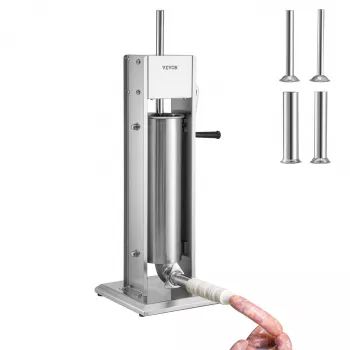
If you’re ready to step up to a larger-batch, hand-crank workflow, the 7L Manual Sausage Stuffer Stainless Steel Vertical Maker with 5 Nozzles for Home & Commercial Use is designed for consistent stuffing with multiple nozzle choices for different casings and styles.
Liters measure volume, so the exact meat weight depends on density and recipe, but a practical range is often around 10–15 pounds per full canister. Leaving a bit of headspace and avoiding overfilling usually makes cranking smoother and helps reduce trapped air.
The nozzle set lets you match the tube diameter to the casing and sausage style—smaller for snack sticks and thin links, medium for standard casings, and larger for thicker sausages. Using the closest-fitting nozzle helps minimize air pockets and reduces stress on casings, especially when the mixture is kept cold.
Pack the canister in layers and tamp gently, then “prime” the stuffer until meat reaches the nozzle tip before loading the casing. Crank steadily, keep the mix cold, and prick any bubbles with a sanitized pin rather than forcing more pressure into the casing.










Leave a comment