HomeBlogBlogMontessori Wooden Arithmetic Board for Early Math Skills

Montessori Wooden Arithmetic Board for Early Math Skills

Montessori Wooden Arithmetic Board for Early Math Skills

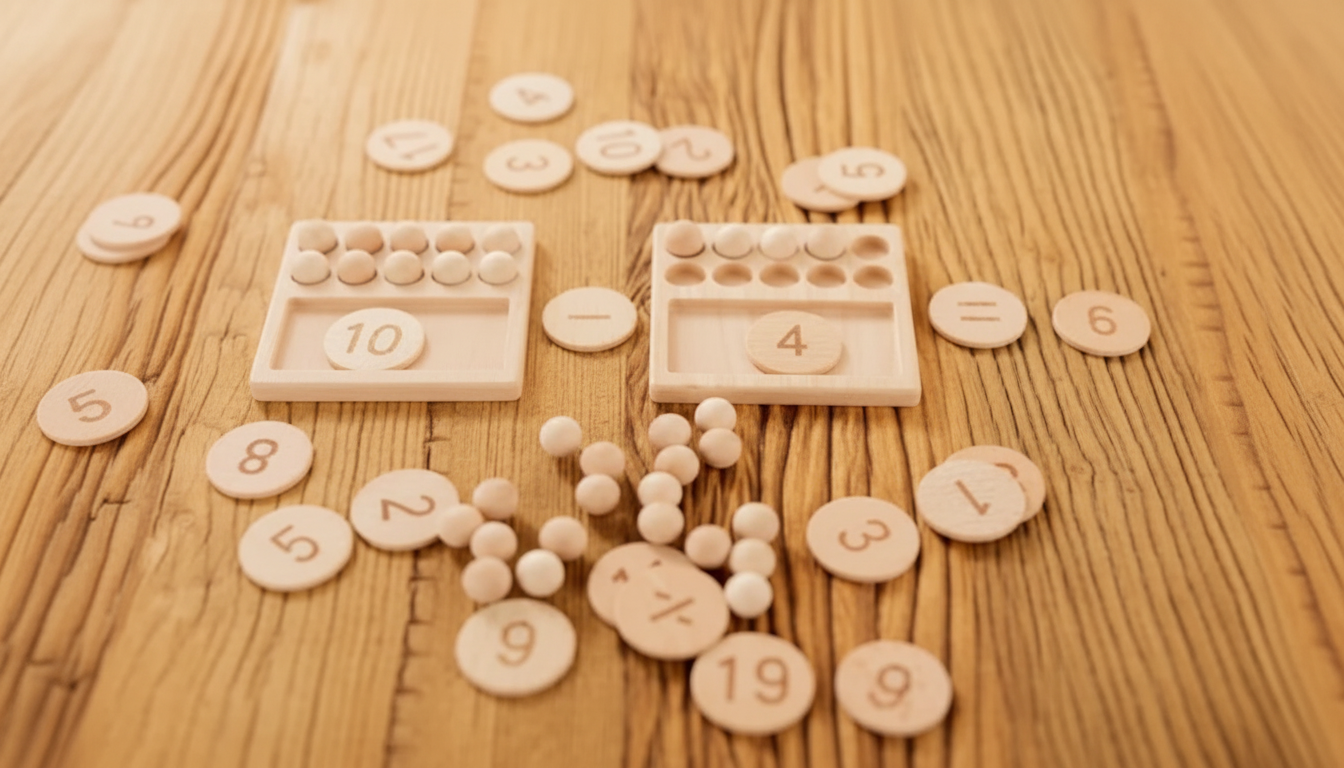
Montessori Wooden Arithmetic Board: Hands-On Number Practice for Early Learners

A wooden arithmetic board turns early math into something children can see, touch, and self-correct. Instead of relying on screens or memorization, this type of Montessori-style material supports counting, number recognition, and simple operations through repeated, independent practice. The result is a calmer, more concrete path to early numeracy—one that lets children learn through their hands, at their own pace, with clear feedback built into the work. For more guidance, see How Montessori Math Builds Strong Foundations.

What This Arithmetic Board Helps Children Practice

  • Number recognition and matching symbols to quantities
  • Counting forward and backward with tactile reinforcement
  • Early addition and subtraction concepts using concrete representations
  • Fine-motor control through moving pieces and tracing/placing elements
  • Focus and independence through repeatable, self-paced activities

Hands-on materials are especially useful in early learning because they connect abstract symbols (like “7”) to real quantities a child can manipulate. This aligns well with developmentally appropriate practice for young children, emphasizing active learning and meaningful, age-appropriate tasks (see NAEYC’s guidance on Developmentally Appropriate Practice). For further reading, see Montessori Basics: How Math Progresses Through the Levels.

A Quick Look at the Montessori Wooden Arithmetic Board

  • Wooden construction designed for frequent handling during daily practice
  • Tabletop-friendly for home learning corners or classroom shelves
  • Fits Montessori-inspired routines: brief presentation, then independent repetition
  • Flexible use for individual work, turn-taking with a sibling, or guided practice with a caregiver

Product snapshot

Item Details
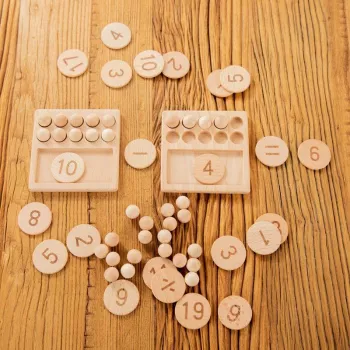
Product Montessori Wooden Arithmetic Board
Price $17.51 USD
Availability In stock
Product page View details

Montessori materials are typically designed to be simple, purposeful, and easy for children to use independently. For a helpful overview of the broader approach, the Association Montessori Internationale (AMI) provides a clear introduction to the Montessori approach, including the role of hands-on, self-correcting work.

How to Introduce It (Simple Lesson Flow)

  1. Start with one concept: counting or number recognition first, then move to operations later.
  2. Give a short demonstration: show one example slowly and clearly, then invite the child to try.
  3. Use consistent language: simple phrasing like “This is 5. Let’s find five.” reduces confusion.
  4. Keep it brief: 5–10 minutes is often enough, especially at the beginning.
  5. End on a high note: stop while interest is still strong, so the board stays appealing.

During early practice, it helps to resist the urge to correct every slip. When children can notice and fix an error through recounting or re-matching, they build confidence and persistence. Choosing well-designed toys and materials that support safe, active learning is also recommended by pediatric guidance on play (see the American Academy of Pediatrics article on selecting appropriate toys for young children).

Activity Ideas That Grow With Your Child

  • Counting hunt: place numbers in order, point to each, and count aloud together—then let the child repeat solo.
  • Match and check: match quantities to numerals, then recount once more to confirm the match.
  • “Make it true” problems: show a simple equation (like 2 + 1) and build the quantities to see if it matches.
  • Speed without pressure: use a gentle timer to repeat a familiar activity for fluency, not perfection.
  • Error spotting: set one intentional mismatch and invite the child to find it and fix it.

These small variations matter because they keep the same tool useful across stages. A child might begin with basic counting and later use the same board for number relationships—like seeing that 6 can be built as 5 and 1, or 3 and 3.

Choosing the Right Fit for Your Space and Routine

  • Size and storage: a board that fits a tray or shelf is more likely to come out daily.
  • Clarity of markings: high-contrast numerals and symbols are easier for early learners to read.
  • Piece handling: parts should be easy for small hands to pinch, place, and remove.
  • Progression: materials that support both counting and early operations stay useful longer.
  • Consistency: using a tool that matches the child’s school or home routines reduces mixed signals.

For many families, the biggest factor is simply accessibility: if the board lives on a reachable shelf and can be set up in under a minute, it becomes part of everyday rhythm instead of a once-a-week activity.

Safety, Care, and Set-Up Tips

  • Use a flat surface to prevent pieces from slipping or dropping during work.
  • Supervise small components for younger children; store parts out of reach when not in use.
  • Clean gently: wipe with a slightly damp cloth and avoid soaking wood or using harsh cleaners.
  • Create a predictable spot: a tray or shelf location encourages independent take-out and put-away.
  • Inspect occasionally for wear (chips, cracks, loose parts) and remove damaged pieces.

Who This Board Tends to Work Best For

More In-Stock Finds for Home Routines

FAQ

What age is a wooden arithmetic board best for?

Many families start in the preschool years through early elementary, but readiness matters more than age. Begin with counting and number recognition, then add simple operations once those basics feel comfortable.

How should a wooden arithmetic board be cleaned and stored?

Wipe it with a slightly damp cloth, avoid harsh cleaners or soaking the wood, and let it fully dry. Store all pieces together in a tray or box, and keep small parts out of reach of toddlers when not in use.

Can this be used for addition and subtraction practice?

Yes—children can build quantities to represent simple equations and confirm the result by recounting. Start with small numbers (like 0–5 or 0–10) and encourage self-checking instead of rushing.

Was this article helpful?

Yes No
Leave a comment
Top

Shopping cart

×